The honest answer to the safety question
Uber at Lima airport is safe. It has been safe for several years. The question gets asked frequently because Lima’s airport has a long-standing reputation for transfer scams, and first-time visitors reasonably want to know whether the rideshare option inherits that risk. It does not — provided you use the service correctly. The risk people associate with “Lima airport taxis” comes from unlicensed drivers soliciting inside the terminal, not from Uber.
This guide breaks down what is actually safe and what is not, the operational details that make Uber work cleanly at the new Jorge Chávez terminal, and the scenarios where a pre-booked private transfer is the smarter choice despite Uber’s lower cost. By the end, you should have an honest assessment of when Uber is the right tool and when it is not.
Where the actual risk lives at Lima airport
The risk profile at Lima airport in 2026 is well-documented and narrow. It concentrates in two places.
The arrivals corridor. Between baggage claim and the public arrivals hall, unlicensed drivers occasionally approach travelers and offer rides. They claim to be airport taxis, sometimes wearing semi-official-looking lanyards. They are not licensed for airport service and have a documented history of overcharging (sometimes 3–5× the legitimate rate), taking detours through unsafe neighborhoods, and in rare cases worse. They are not Uber drivers. Uber’s policy explicitly prohibits its drivers from soliciting passengers inside terminals.
The standard arrivals curb. Some unlicensed drivers stage near the regular taxi curb and try to intercept rideshare passengers walking toward the official pickup zone. They sometimes claim to be your Uber. Verify the driver’s plate against the app — if it does not match, they are not your driver.
Outside these two specific contexts, Lima airport’s safety profile is unremarkable. The terminal itself is well-policed, the arrivals hall is well-lit, and the official rideshare zone has uniformed staff during peak periods.
How the Uber pickup zone works at the new terminal
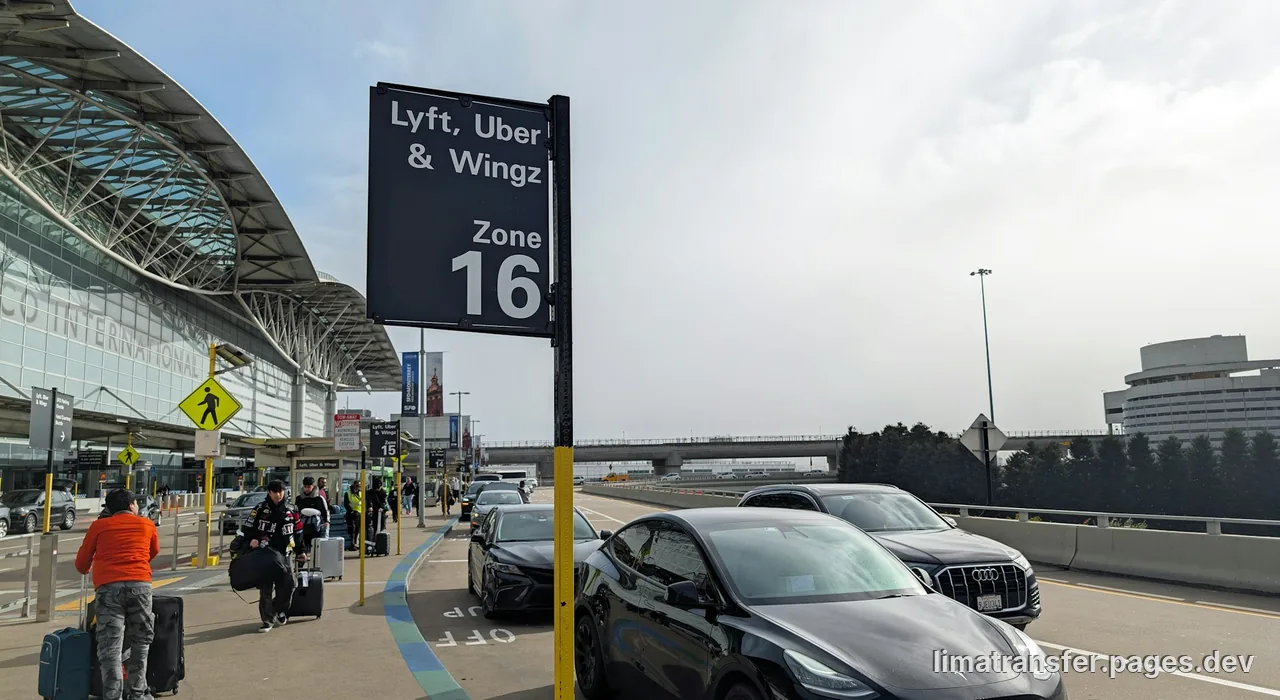
When the new Jorge Chávez terminal opened in June 2025, the rideshare pickup arrangement was redesigned. Uber and Cabify drivers cannot pick up at the main arrivals curb — they wait at a designated staging area on the opposite side of the parking deck, reached by a covered pedestrian bridge from the upper-level arrivals hall.
The workflow:
- Exit the arrivals hall through the main curb doors.
- Follow signage marked Transporte por aplicación. The signs are clearly marked in Spanish and English with arrow pictograms.
- Cross the covered pedestrian bridge. The walk is roughly 4 minutes from the arrivals hall to the staging area, longer with multiple suitcases.
- Wait in the staging area before requesting the ride. The area has shaded seating and numbered pickup bays. Request your ride only after you have arrived in the staging area, not from inside the terminal — drivers cancel quickly if they cannot reach you.
- Verify the driver’s license plate inside the app before approaching the vehicle. This is the most important step. Lima has occasional reports of unlicensed drivers staging in the zone and offering rides to tentative-looking travelers. The app’s plate display protects against this.
The bridge and staging area are open 24 hours. Surge pricing kicks in based on overall airport demand; the most aggressive surge window is 11 PM to 4 AM.
When Uber is the right choice
Three traveler profiles get the best value from Uber at Lima airport.
Daytime solo travelers with light luggage. Off-peak hours (10 AM–noon, mid-afternoon) see no surge and reliable driver supply. A Miraflores trip runs $15–$22 USD with a 5–10 minute wait. This beats a pre-booked private transfer on cost by $5–$10 USD per trip with minimal reliability trade-off.
Pairs with carry-on luggage only. Two travelers in an Uber sedan to Miraflores typically pay $18–$26 USD total. Splitting the cost makes it the cheapest reasonable option that does not involve a pedestrian bridge to a bus stop.
Travelers who have used Uber in other Latin American cities. Lima’s Uber works essentially identically to Mexico City, Bogotá, or Buenos Aires. If you are comfortable with the workflow in those cities, the Lima version requires no new mental model.
When a pre-booked private transfer is smarter
Three scenarios where Uber underperforms:
Late or pre-dawn arrivals. Surge pricing between 11 PM and 4 AM can push a $20 USD daytime fare past $40 USD. A pre-booked private transfer locks the rate at $22–$32. The cost advantage flips entirely overnight. Most travelers landing on long-haul flights from Europe or North America hit this window — the timing alone often justifies pre-booking.
Tight schedules and first visits to Lima. Pre-booked drivers track your flight, wait inside the terminal with a name placard, and dispatch automatically based on landing time. Uber drivers cancel quickly if you do not appear at the pickup zone within 5–10 minutes of acceptance, forcing a re-request that may catch surge pricing. For travelers with hotel check-in windows or business meetings, the pre-booked tier removes meaningful variance. Local operators like limatransfer.com handle this scenario for $22–$32 USD per sedan with full flight tracking.
Groups of three or four with full luggage. Two Ubers cost more than one pre-booked SUV, and the coordination overhead is meaningfully higher (two drivers, two routes, two arrival times at the hotel).
Safety details that actually matter
A few smaller details shape the actual safety experience.
Always verify the plate. The single most important safety habit at the Lima rideshare pickup zone. Do not get into any vehicle without confirming the plate matches the app. Unlicensed drivers occasionally claim to be your Uber and rely on travelers not double-checking.
Sit in the back seat. Lima Uber convention is back-seat passengers. Front-seat occupancy is uncommon and sometimes flagged by drivers as a potential issue.
Confirm the destination address aloud. Drivers occasionally route to the wrong hotel by GPS error. Confirming the address in conversation before departure prevents the wrong-hotel scenario.
Use the app’s emergency button if something feels off. Lima Uber has the standard in-app emergency feature with location sharing to local police. We have never used it; the option exists.
Cabify vs Uber at Lima airport
Both operate from the same official pickup zone with essentially equivalent safety profiles. Some practical differences:
Cabify dispatches slightly newer vehicles on average — the fleet is curated more tightly than Uber’s. Cabify’s higher minimum vehicle standards translate to a marginally more polished experience.
Uber has higher driver supply at the airport, leading to shorter wait times during peak hours. Cabify wait times can run 8–12 minutes during peak windows; Uber typically clears at 3–6 minutes.
Pricing is roughly equivalent at the sedan tier. Both apply surge during the same overnight windows.
Cabify’s cash handling is cleaner for travelers without local cards loaded. Uber technically supports cash but the experience is occasionally buggy.
For most travelers, the right answer is “whichever app you already have installed.” If you are choosing between them fresh, Cabify is the safer default for a Lima first trip.
Closing notes
Uber at Lima airport in 2026 is safe, well-integrated with the new terminal, and the best-cost option for daytime solo or pair arrivals. The risk profile that gives Lima airport its reputation lives entirely with unlicensed drivers soliciting in the terminal, not with Uber. For late arrivals, groups, or first-trip travelers who value certainty over cost savings, a pre-booked private transfer remains the cleaner choice. The compare page on this guide covers the head-to-head economics across all three transfer tiers.