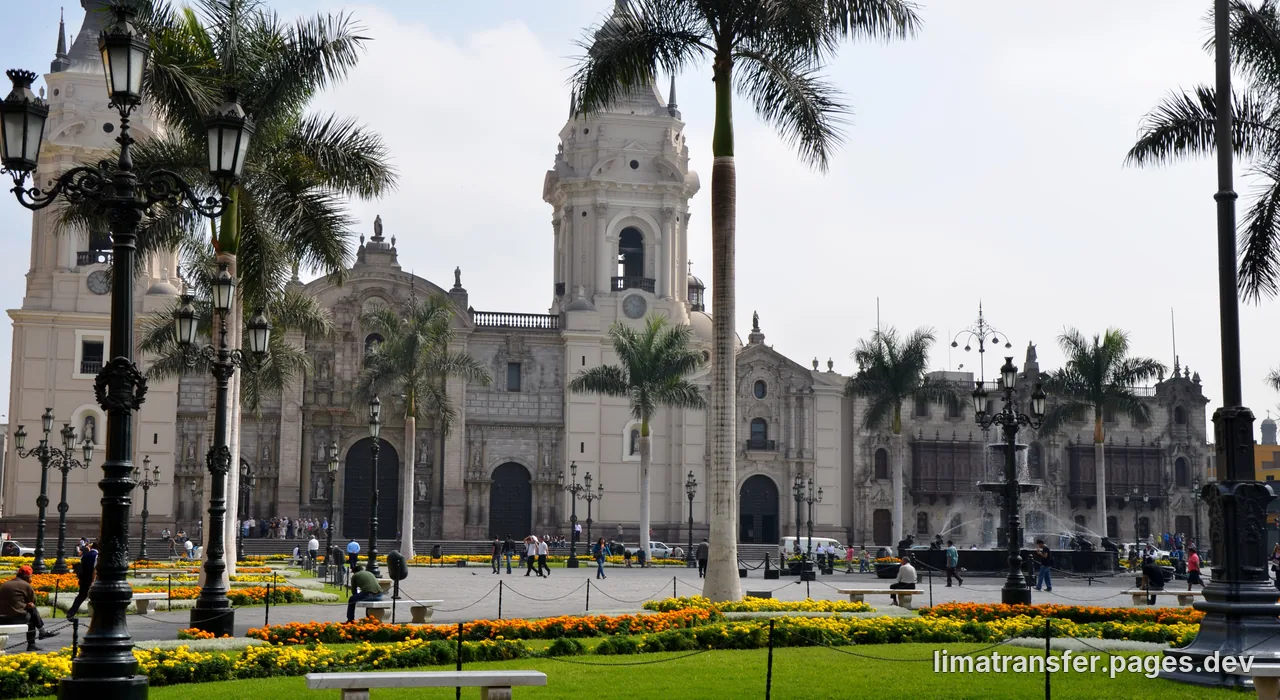
Why Centro Histórico is the shortest airport leg
Lima’s old town sits roughly 11 kilometers east of the airport, the closest of the major visitor districts. The drive crosses dense industrial zones in Callao and the working-class districts of Cercado de Lima before reaching the UNESCO-listed colonial grid around Plaza Mayor, the Cathedral, and the Government Palace. The corridor is fast off-peak and walkable on arrival — most major hotels sit on paved avenues with driveway access, and the tourist circuit fans out from Plaza Mayor across roughly six pedestrian blocks.
Visitors pick Centro Histórico for daytime sightseeing — the Cathedral, the Catacombs of San Francisco, and the Government Palace ceremony. The neighborhood is rarely the first choice for multi-day stays because four- and five-star inventory is thinner than San Isidro or Miraflores. The case for staying overnight is best for travelers who prioritize colonial architecture, plan early-morning visits before tour buses arrive, or want the cheapest sleep close to the city’s historical core.
Step-by-step: from new terminal arrivals to your downtown hotel
Centro Histórico arrivals follow the same airport flow as Miraflores or San Isidro, with one neighborhood-specific drop-off nuance: pedestrian blocks.
- Clear immigration and baggage claim. Allow 20–40 minutes through immigration during morning peaks; baggage typically appears within 25 minutes. Most nationalities no longer fill arrival cards.
- Decide your transfer type before exiting baggage. Confirm your pre-booking, prep your rideshare app, or remember the airport taxi counter logo.
- Walk through customs into the arrivals hall. Overhead signage points to “Taxis Oficiales,” “Transporte por aplicación,” and the pre-booked transfer corridor.
- Find your driver or queue your service. Pre-booked drivers wait with name placards. Airport taxis are booked at a counter inside the terminal. Rideshare passengers walk to the app pickup zone across the covered pedestrian bridge.
- Confirm name, plate, and price. Match the booking against the vehicle. Reject any driver who waves you toward a different car.
- Expect a direct inland route. Drivers exit the airport via Avenida Faucett and take Avenida Argentina or Avenida Venezuela east to downtown. The Costa Verde coastal advantage does not apply to Centro Histórico — the routing is straight inland.
- Confirm drop-off accessibility. If your hotel sits on a pedestrian block (e.g., parts of Jirón de la Unión), the driver will stop at the nearest paved corner. Plan for a one- to two-block walk with luggage.
What the route actually looks like
The trip is the most direct of the city’s main corridors. Avenida Faucett carries you out of the airport into Callao’s industrial zone. Avenida Argentina is the dominant east-bound artery — multi-lane, no traffic lights for long stretches, and a quick run into the Cercado de Lima district that sits just outside the historical core. Avenida Venezuela is the secondary option that runs parallel two kilometers north, used when Avenida Argentina is congested.
Downtown’s grid is colonial: wide primary streets (Avenida Tacna, Avenida Abancay) framing narrower interior blocks. Drivers know the major hotels — Sheraton, Country Plaza, Costa del Sol Wyndham, Bolívar — and pull straight into their driveways. Boutique properties tucked into smaller streets sometimes require last-block navigation, especially Hotel B Histórico and a handful of newer pedestrian-zone B&Bs that opened during the 2019–2024 colonial-zone restoration push.
Price dynamics: the cheapest major corridor
Centro Histórico is the cheapest pre-booked private transfer of the major Lima visitor districts. The shorter mileage (11 km vs Miraflores’s 16 km) translates directly to a $4–$7 USD price gap. Operators do not stack a downtown surcharge, partly because the drive is on highway most of the way and partly because the route is one of the highest-volume corridors for Peruvian travelers as well as international visitors.
Rideshare apps are similarly cheaper to Centro Histórico — $12–$22 versus $15–$28 for Miraflores under the same conditions. Surge pricing applies during the same 11 PM–4 AM window, so the cost advantage compresses overnight. For groups of three or four, the per-head cost of a pre-booked minivan can drop below $10 USD, which is competitive with the shared shuttle once you factor in time savings.
Most travelers do not need an SUV to Centro Histórico because the trip is short and traffic is moderate. If you are coming directly from a flight and want to book here for a fixed price without monitoring app surge, a pre-booked sedan is usually $5–$8 USD below the airport taxi counter for equivalent vehicle class.
Safety: the most context-dependent of the major districts
Centro Histórico has the most variable safety profile of the four major visitor districts, and the context that matters is time of day. Daytime, especially around the Plaza Mayor tourist circuit, is well-policed, full of tour groups, and one of the most pleasant walks in Lima. Evening and overnight, especially on smaller streets two or three blocks off the main grid, the foot-traffic density drops sharply and the area starts to feel like a working downtown — which it is.
Airport-side safety is identical to other Lima corridors. Never accept rides from anyone soliciting in the terminal; use the official taxi counter or designated rideshare zone; confirm driver and plate before getting in. The neighborhood-specific guidance: do not walk between bars or restaurants after dark, even short distances. Use rideshare or pre-booked transport for any movement after 9 PM. Pick hotels with staffed reception 24 hours.
A practical detail for late arrivals: if your flight lands after 10 PM and you are staying in Centro Histórico, pre-book the transfer. The arrivals area is open but quieter at that hour, and the downtown drop-off context is less forgiving than Miraflores. Intui Travel is one operator that handles downtown late-night bookings; cross-check against a local Lima provider for pricing.
A note from someone who books here for daytime trips
I stay in Miraflores most visits, but I have booked Centro Histórico a dozen times for specific reasons — colonial architecture projects, early-morning Catacombs visits, or solo working trips on a budget. The airport leg has never been the friction point. It is short, direct, and cheap. If you are going to Centro Histórico for the right reasons — early sightseeing, colonial focus, budget — the airport corridor is the easiest in the city.
When pre-booking pays off
Pre-book a private transfer to Centro Histórico if you arrive after 9 PM, are staying at a smaller boutique hotel without 24-hour reception, travel with three or more passengers, or want fixed pricing without surge risk. Daytime solo travelers with light luggage can use the rideshare zone or the airport taxi counter and save $5–$8 USD versus a pre-booked sedan.
For tour groups arriving together — common in Centro Histórico because the neighborhood draws cultural-itinerary bookings — a minivan booked through a local operator removes the coordination friction of multiple sedans. Per-head cost drops below $10 USD for parties of five or more. If you are pre-booking same-day, 4–6 hours of lead time is usually enough; for early-morning meetings or museum opening slots, 24–48 hours ahead is safer.
Tipping, payment, and luggage protocol
Tipping is not customary on pre-booked Centro Histórico transfers. Rounding up to the nearest 5 or 10 soles is appreciated. Hotel doormen at the four-star chains expect 5–10 soles for luggage handling; smaller properties usually have a single front-desk staffer doing everything. Card payment is standard for pre-booked transfers, with airport taxis accepting both card and cash. Rideshare drivers settle through the app. Luggage protocol is unremarkable.
Closing notes
Lima airport to Centro Histórico is the shortest, cheapest, and most direct of the major visitor corridors. The trade-offs are downtown’s thinner hotel inventory and the more context-dependent overnight safety profile — both of which are manageable with a small amount of planning. For daytime cultural visits, the corridor is a quiet win; for multi-day stays, weigh the trade-off against Miraflores or Barranco.