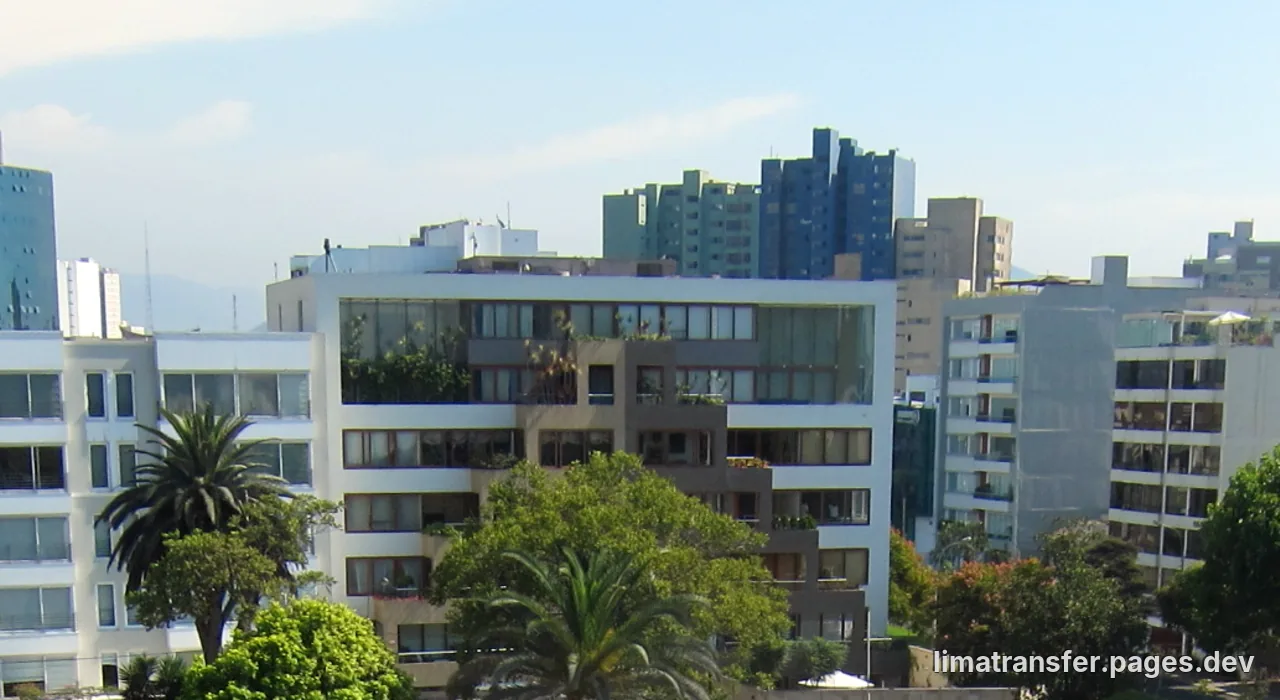
Why San Isidro is the default business stay
San Isidro is Lima’s financial and diplomatic district. It is where multinational regional offices, embassies, and most of the city’s five-star hotel chains sit — Country Club Lima Hotel, Westin Lima, Hilton, Hyatt Centric, Sonesta El Olivar, and several smaller premium properties cluster around the El Olivar olive grove park and Avenida Javier Prado. Travelers who pick San Isidro over Miraflores or Barranco usually do it for a specific business reason: a conference at a Javier Prado venue, an embassy appointment, a regional team meeting, or a corporate-policy hotel cap that rules out higher-cost neighborhoods.
The airport corridor handles San Isidro slightly differently from Miraflores. The neighborhood sits one to two kilometers inland of the coast, so the Costa Verde shortcut is only partially useful. Most experienced drivers blend the Costa Verde with a Vía Expresa or Avenida Javier Prado inland segment, picking the mix based on real-time traffic. This makes the trip 5–10 minutes shorter than Miraflores at off-peak times but 5–15 minutes longer in morning rush.
Step-by-step: from new terminal arrivals to your San Isidro hotel
The arrival flow is identical to other Lima neighborhoods. The neighborhood-specific variance is at the drop-off, where premium hotels have stricter pull-up protocols.
- Clear immigration and baggage claim. Allow 20–40 minutes through immigration during morning peaks; baggage typically appears within 25 minutes. Most nationalities no longer fill out arrival cards.
- Decide your transfer type before exiting baggage claim. Confirm your pre-booking, prep your rideshare app, or note the airport taxi counter logo before stepping into the arrivals corridor.
- Walk through customs into the arrivals hall. Overhead signage points toward “Taxis Oficiales,” “Transporte por aplicación,” and the pre-booked transfer corridor with name placards.
- Find your driver or queue your service. Pre-booked drivers wait in a roped greet area. Airport taxis are booked at a counter inside the terminal. Rideshare passengers walk across the covered pedestrian bridge to the app pickup zone.
- Confirm name, plate, and price before getting in. Match your booking against the vehicle. Reject any driver who waves you toward a different car.
- Expect a traffic-aware route choice. Off-peak: Vía Expresa is fastest. Morning rush: Costa Verde hybrid is safer. The driver will pick.
- Five-star drop-off protocol. Premium hotels typically have a covered porte-cochère for vehicle drop-off. Drivers know to pull in there, and the doorman handles luggage. Tipping the doorman 5–10 soles is customary, separate from any tip you give the driver.
What the route actually looks like
The first leg from the airport along Avenida Faucett is identical to the Miraflores and Barranco corridors — dense, industrial, with professional drivers locking doors at intersections. The split happens around the Magdalena del Mar entrance. Costa Verde drivers continue south and exit at Avenida Javier Prado from the west, climbing to San Isidro from the coast. Vía Expresa drivers stay inland and approach San Isidro from the east via Javier Prado or Avenida Aramburú.
The neighborhood itself is quieter than Miraflores. Streets near the El Olivar park are residential and tree-lined; the financial cluster around Avenida Rivera Navarrete and Avenida República de Panamá is denser but well-paved. Five-star hotels sit on or near these primary avenues, so drivers do not navigate narrow lanes. The exception is a few boutique properties tucked into quieter residential blocks — confirm the exact pickup point in your booking notes if you are not staying at a chain.
Price dynamics for the San Isidro corridor
San Isidro fares sit roughly even with Miraflores at the sedan level — both routes are ~15 kilometers and use overlapping highway segments. SUV and minivan rates are also close. The two outliers are time-of-day surcharges and hotel-sedan premium pricing.
Surcharges hit rideshare apps hard between 11 PM and 4 AM, sometimes pushing Uber and Cabify into the $30–$40 USD range for the same trip that costs $22–$25 on a pre-booked private sedan. The 2026 surge curve is more pronounced than it was in 2024, partly because more international travelers know to use rideshare and the demand pool concentrates around late arrivals.
Hotel-sedan premium pricing is the second outlier. Five-star concierges offer transfers at $40–$60 USD, which is 60–100% above the pre-booked independent rate. The hotel premium pays for white-glove arrivals-hall greeting and a uniformed driver. Independent operators (limatransfer.com among the local options worth checking) provide equivalent service at $22–$30. The economics rarely favor the hotel sedan unless your company explicitly reimburses it.
Safety: business district nuances
The airport-side safety profile is identical to other Lima neighborhoods. Never accept rides from anyone soliciting in the terminal; only use the official taxi counter or designated rideshare zone; confirm driver and plate before getting in.
San Isidro-specific safety is unremarkable. The neighborhood has the lowest crime profile of the major Lima visitor districts — better than Miraflores, much better than Centro Histórico. The areas immediately adjacent to San Isidro (Surquillo to the south, Lince to the north) have a slightly elevated risk profile that does not affect transfer drop-offs but matters if you wander on foot at night.
A practical detail for late arrivals: many San Isidro residential streets have private security booths at corner intersections, staffed by neighborhood-funded vigilantes. They are not police but they are watchful and helpful. If you are looking for an address late at night and the driver is uncertain, the security booth attendant will often confirm the block — a small but useful texture of the neighborhood.
A note from someone who books San Isidro for work
I cover Lima for business clients about four times a year and San Isidro is the default. The El Olivar perimeter has the cleanest balance I have found anywhere in the city — five-star hotel quality at sedan-level transfer prices, walking distance to corporate offices, and a 40-minute airport leg when traffic cooperates. The downside is the morning rush penalty: if my flight lands at 6 AM and my first meeting is at 9, I plan the transfer assuming 70 minutes door-to-door, not 40.
Most of my recent trips have used limatransfer.com as the sedan operator, in part because corporate billing is set up and in part because the dispatcher knows my flight pattern. The first booking is the friction point; everything after that is just calendar invites.
When pre-booking pays off
Pre-book a private transfer to San Isidro if you arrive between 11 PM and 6 AM, have a meeting within four hours of landing, travel with three or more passengers and luggage, or are staying at a five-star where check-in time matters. Daytime solo arrivals with light bags can use the rideshare zone or the airport taxi counter for a $5–$10 USD saving.
If you are traveling for a conference with five or more team members, the minivan booking is the obvious choice — per-head cost drops below $10 USD and you avoid coordinating separate sedans. For groups of two or three with carry-on luggage only, a sedan is sufficient and reduces vehicle cost. Kiwitaxi is one aggregator that handles San Isidro corporate bookings; cross-checking against a local operator usually finds 15–25% in savings for equivalent service.
Tipping, payment, and luggage protocol
Tipping is not customary on pre-booked San Isidro transfers. Many travelers round the soles total up to the nearest 5 or 10, which is appreciated. Doorman tipping at premium hotels is a separate convention — 5–10 soles when the doorman handles luggage. Card payment is standard for pre-booked transfers; airport taxis accept both card and cash; rideshare drivers settle through the app. Luggage protocol is unremarkable: bags in the trunk, daypacks and valuables in the cabin, group minivans sometimes split luggage across a third row.
Closing notes
Lima airport to San Isidro is the most predictable major corridor in the city. Premium hotel infrastructure, well-paved primary avenues, and an established pre-booking culture among local operators mean the transfer leg should not be a source of friction for business travelers. The two scenarios worth planning for are morning rush traffic and 11 PM–6 AM rideshare surge. Both are solved by pre-booking 24–72 hours ahead through a licensed operator with corporate billing support.