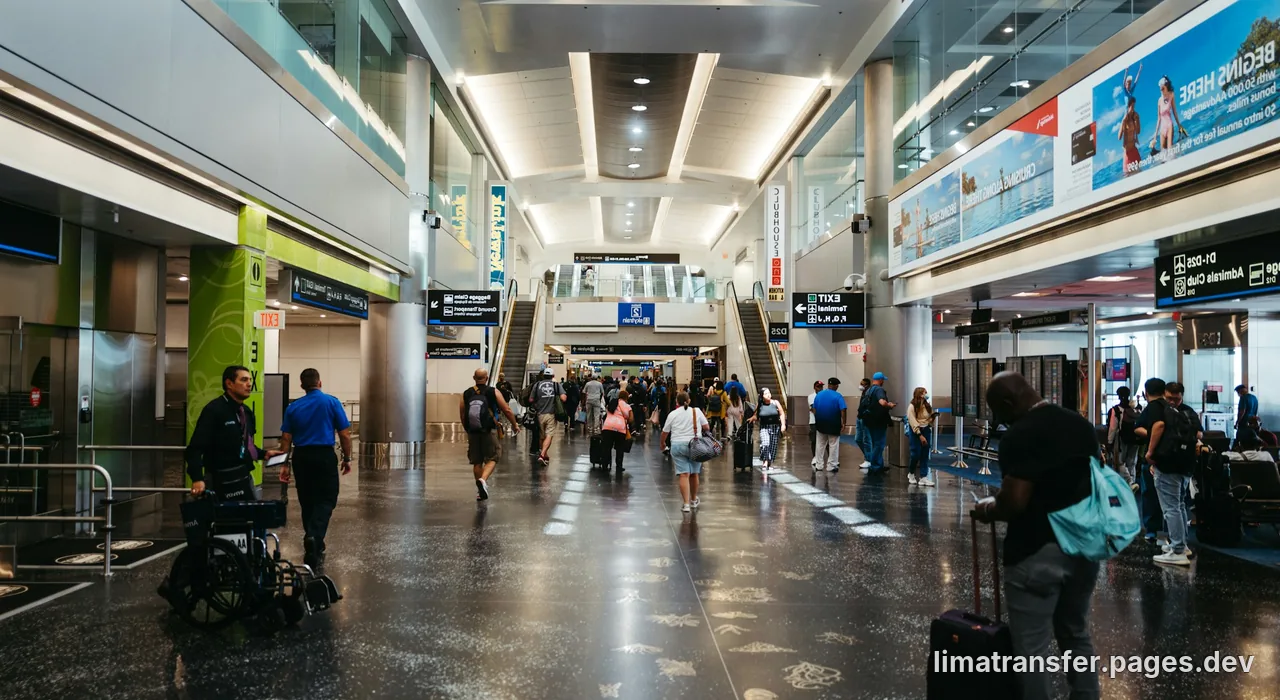
What the Lima arrivals flow looks like in 2026
Arriving at Lima’s Jorge Chávez International Airport in 2026 is meaningfully easier than the old-terminal experience that defined the airport pre-June 2025. The new building has wider corridors, better signage, and a much larger arrivals hall, all of which absorb the chronic crowding that used to make a first arrival in Lima stressful. The flow itself is unchanged in structure: immigration first, then baggage, then customs, then the public greeting area where you find your transfer.
This guide walks through each step with the practical details that matter — what documents you need, how long each stage typically takes, where the ATMs and SIM kiosks are, and how to leave the terminal cleanly without getting routed to an unlicensed driver. The goal is for a first-time visitor to land in Lima and be in their hotel within 90 minutes, no surprises.
Step 1: Disembark and walk to immigration
Most international flights into Lima park at the international gates on the eastern half of the terminal, putting immigration about a 4–6 minute walk from the jet bridge. Domestic and short-haul Latin American flights tend to use the western gates, closer to baggage. Follow the overhead signs marked Inmigración / Immigration — the new terminal’s signage is bilingual throughout.
The corridors widen as you approach immigration. There are bathrooms before the queue if you need them — useful if your last bathroom break was hours before landing. There is no shopping or food in this corridor; that comes later, on the departures side.
Step 2: Clear immigration
Peru eliminated the paper arrival card for most nationalities in 2023. The immigration officer scans your passport, asks one or two questions about purpose and length of stay, and stamps you in. The standard tourist stamp is 90 days. If you need longer, request it at the booth — many officers will issue a 183-day stamp on request for tourists who explain a multi-country itinerary.
Queue times vary substantially. Morning peaks (10 AM–noon) regularly run 20–40 minutes. Off-peak windows (early afternoon, late evening) drop to 5–15 minutes. There are e-gates for Peruvian and select South American nationalities; international visitors use the staffed counters. The queue snakes through a stanchioned corridor with seating along the edges for travelers who need it.
A small number of nationalities still require an arrival declaration form. Check the Peruvian migration authority’s website (migraciones.gob.pe) for current rules if your passport is from a less common origin country.
Step 3: Collect baggage
The new terminal’s baggage hall has twelve carousels arranged in two rows. Overhead boards list which carousel handles which flight. Bags typically appear within 15–25 minutes of landing — sometimes faster, sometimes longer during peak periods when multiple flights land simultaneously. The hall is larger and quieter than the old terminal’s chronically crowded carousels.
While you wait, this is a good moment to switch on cellular data if you have international roaming, or to look for the airline service desk if any of your bags are missing or damaged. The Avianca, LATAM, and major US carriers have desks adjacent to the baggage hall for in-the-moment lost-bag claims.
Step 4: Walk through customs
Customs uses a green/red channel system. Green is the no-declaration channel; red is for travelers with goods over the duty-free allowance or carrying restricted items. Most tourists take green and walk through without inspection. The customs corridor is short — usually a 1–2 minute walk — and customs officers spot-check a small percentage of passengers randomly. Have your bags ready in case you are selected.
Peru’s duty-free allowance is generous for personal effects but restrictive for commercial-quantity items. Common items that trip up first-time visitors: large quantities of alcohol or tobacco, unprocessed agricultural products, and uncertified cash transfers above $10,000 USD equivalent. None of these affect typical tourist trips.
Step 5: Enter the arrivals hall and find your transfer
You exit customs into the upper-level arrivals hall — the large public space where pre-booked drivers, hotel transfers, and family members wait. This is the most operationally important moment of the arrival because the wrong choice here is the most common Lima first-trip mistake.
Pre-booked transfer passengers: Look for your driver in the roped meet-and-greet zone, on the inside of a permanent barrier just past the customs exit. Drivers hold placards with the passenger name in 20–30 cm letters. They do not move into baggage claim, customs, or the curb area. If your driver is not visible, contact the operator’s WhatsApp number on your booking confirmation. Most operators including LimaTransfer staff a 24-hour dispatch desk for arrival-day issues.
Airport taxi passengers: Walk to the official taxi counter on the right side of the arrivals hall, before the curb doors. Two licensed operators staff counters. Quote your destination, pay by card or cash, and receive a printed dispatch slip with the assigned driver’s name and plate. Proceed to the curb and wait 5–10 minutes.
Rideshare passengers: Exit the arrivals hall through the main curb doors, then follow signage marked Transporte por aplicación across a covered pedestrian bridge to the rideshare staging area on the opposite side of the parking deck. The walk is about 4 minutes. Request your ride from the staging area, not from inside the terminal. Confirm the driver’s plate in the app before approaching the vehicle.
What to do about money before you leave the terminal
The post-customs ATMs are the easiest way to get soles for the trip. Four major Peruvian banks operate machines in the arrivals hall: BBVA, BCP, Interbank, and Scotiabank. All four accept international cards. Withdrawal limits run S/ 700 to S/ 1,400 per transaction depending on the bank, and per-day limits apply. Use a card with no foreign transaction fee or a low-fee travel card; the interbank exchange rate the ATM uses is competitive.
The airport currency exchange counters offer 5–10% worse rates than ATM withdrawals. Skip them unless you specifically need physical USD or EUR cash, which most travelers do not. Card payment covers pre-booked transfers, rideshare, restaurants, and most retailers in Lima — soles cash matters mostly for tips, small market purchases, and emergency fallback.
How much to withdraw depends on your itinerary. For a first-day-only buffer, S/ 200–S/ 400 (~$50–$100 USD equivalent) is enough. Travelers heading directly to a Miraflores hotel by pre-booked transfer often do not need cash at all on day one.
Getting a Peruvian SIM card
If you do not have international roaming, the SIM kiosks in the arrivals hall are the cleanest way to set up Peruvian cellular service. Three operators run kiosks: Bitel, Movistar, and Claro. All three offer prepaid plans starting at S/ 35 (~$10 USD) for 14 days of data with calling minutes included. The kiosk staff handles SIM activation and KYC paperwork — bring your passport.
For most travelers, Movistar and Claro offer the strongest coverage in Lima and across the major tourist circuits (Cusco, Machu Picchu, the Sacred Valley, Arequipa). Bitel is the budget option and works well in the city but has thinner coverage in rural Andean regions. eSIM activation is supported by all three operators if your phone is compatible.
Leaving the terminal
Once you have your driver, taxi, or rideshare confirmed, the actual exit is unremarkable. The curb doors open to a covered drop-off zone; pre-booked drivers walk you to the vehicle, taxi counter dispatches assign a specific vehicle for you to walk to, and rideshare passengers walk across the pedestrian bridge to the staging area before connecting with their driver.
The drive to Miraflores typically takes 45–75 minutes; San Isidro is 40–70; Barranco is 55–85; Centro Histórico is 30–55; Callao cruise port is 20–40. These ranges account for the post-2025 terminal’s added 15–20 minutes versus pre-terminal-move drive times.
Final preparation tips before you fly
Three small preparation steps make the arrival significantly smoother. Save the operator dispatch WhatsApp number to your phone before you fly, so you can reach them without app-switching after landing. Screenshot your booking confirmation in case the airport Wi-Fi is slow when you land. Carry your passport in an easy-access pocket rather than buried in luggage — immigration moves faster when you are not unzipping bags at the booth.
Closing notes
Lima airport arrivals in 2026 are smoother than they used to be, but the basic rules have not changed: never accept rides from unlicensed drivers soliciting in the terminal, use ATMs (not currency counters) for soles cash, pick up a SIM card before you leave the airport, and rely on a pre-booked transfer or official airport taxi counter rather than improvising at the curb. The destination pages cover the per-neighborhood trip details; the terminal guide walks the architectural layout in more depth.