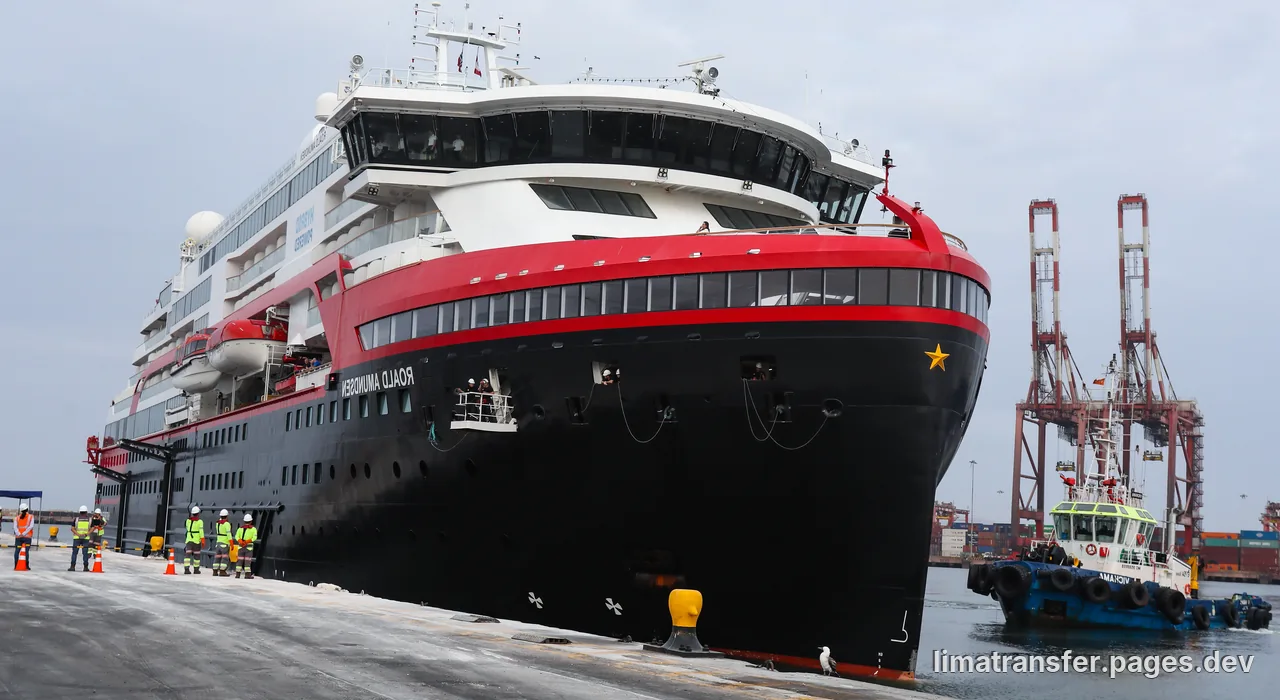
Why the Callao cruise transfer is its own category
Most Lima airport transfers run inland to a hotel. Callao is the exception: a short coastal hop to a cruise terminal with a hard time deadline. The Callao cruise port — formally Muelle Sur, the southern passenger pier — handles around 90% of Lima’s cruise traffic. Ships dock for a single day, board passengers in a 4–6 hour window, and depart. Miss the boarding window and the next port option is days away by air, which is why this corridor demands more precise planning than any other Lima airport route.
The geographic advantage is significant. Callao port sits about 7 kilometers north of the airport along the same coastal industrial corridor that the rest of Lima’s airport transfers cut through to reach the city. For cruise passengers, the trip is shorter, cheaper, and more predictable than any hotel-bound leg. The trade-off is the timing pressure: a pre-booked transfer with flight tracking is no longer a nice-to-have, it is the default.
Step-by-step: from new terminal arrivals to cruise check-in
Cruise arrivals add three steps to the standard Lima airport flow — port entry, terminal-specific drop-off, and cruise check-in. The pre-arrival timing matters more than for any other Lima corridor.
- Clear immigration and baggage claim. Allow 20–40 minutes through immigration; baggage typically appears within 25 minutes. For cruise arrivals, an extra immigration buffer is worth building in.
- Confirm your boarding window before exiting baggage. Your cruise line’s pre-boarding email lists the latest boarding time. Mentally subtract 30 minutes for port-entry traffic and security.
- Walk through customs into the arrivals hall. Pre-booked transfer drivers wait with name placards in the roped greet area, often with a sign indicating the cruise line.
- Find your driver. Cruise-bound passengers should always pre-book — rideshare and airport taxis do not handle the boarding-window risk. Match the booking against the vehicle and confirm the cruise line name with the driver before getting in.
- Expect a fast coastal route. Drivers exit the airport via Avenida Faucett and take Avenida Néstor Gambetta north toward the port complex. The route avoids city traffic entirely.
- Port entry and Muelle Sur access. Cruise vehicles enter through dedicated access lanes at the port perimeter. Drivers present cruise-line documentation at the gate, which is why pre-booked operators are the safe choice. The driver routes to the correct passenger building based on the cruise line.
- Drop-off and porter handoff. Cruise terminal porters handle luggage from vehicle drop-off to ship check-in. Tipping is customary — $1–$2 USD per bag is standard.
What the route actually looks like
Avenida Faucett carries you out of the airport into the southern edge of the Callao district. The split for cruise-bound traffic happens at Avenida Néstor Gambetta — drivers heading to Miraflores or San Isidro continue south, while cruise traffic turns north toward the port complex. The route stays on multi-lane primary arteries and avoids residential districts entirely. Industrial cargo traffic shares the roads, especially during weekday business hours, but the short distance limits overall exposure.
Port entry itself is the most variable segment. On single-ship arrival days the access lanes are quiet and the drive from gate to drop-off takes 5 minutes. On multi-ship days (especially during peak Lima cruise season from November to March) the queue can stretch 15–20 minutes inside the port perimeter. Pre-booked operators monitor port-arrival schedules and pad their estimates accordingly.
Price dynamics: cheapest by every measure
Callao is the cheapest major Lima airport transfer at every vehicle tier. Pre-booked private sedans start at $15 USD, SUVs at $25, and minivans at $35. The short distance is the main driver — fewer kilometers translate directly to lower fares — but the corridor’s high cruise-day volume also keeps the market competitive. Operators do not need to recover marketing cost over a long drive, so margins on the trip are tighter and savings get passed to the customer.
The exception is cruise-port handling fees. Some operators add a $3–$5 USD surcharge for the documentation work required at the Muelle Sur access gate. The fee is fair — driver paperwork takes 5–10 minutes per trip — but worth confirming before booking. Local Lima operators (limatransfer.com among them) tend to bundle this into a flat rate rather than itemizing. Aggregators sometimes display the headline price without the cruise surcharge and add it at checkout, which is worth watching for.
Rideshare is technically allowed for Callao port drop-off but is a poor choice for cruise passengers. The reasons: drivers cannot present cruise-line documentation at the access gate (forcing a drop at the perimeter and a long walk with luggage), surge pricing on cruise-arrival mornings frequently pushes the price above pre-booked rates, and Uber’s wait-tolerance for delayed flights is too short for safe cruise margins. To check current rates for pre-booked transfers, compare against the airport taxi counter at the terminal.
Aggregator price-comparison shopping is reasonable for Callao bookings. GetTransfer lists Callao port transfers with typical sedan quotes in the $25–$35 USD band, with aggregator markup. Local Lima operators usually undercut this by 15–25% for equivalent service plus the cruise-port paperwork.
Safety: airport flow plus port-side specifics
Airport-side safety is identical to other Lima corridors. Never accept rides from anyone soliciting in the terminal; only use the official taxi counter, designated rideshare zone, or pre-booked driver. Confirm name, plate, and price before getting in.
Port-side safety is straightforward for cruise passengers. Muelle Sur has secured perimeter entry, on-duty Peruvian National Police, and cruise-line staff handling passenger areas. The neighborhoods immediately outside the port complex have a more variable safety profile and are not recommended for casual wandering. Cruise passengers staying on the official port-and-ship path encounter none of this.
A note from someone who has run this for cruise clients
I have arranged the airport-to-Callao leg for a handful of cruise passenger groups, and it is the most operationally tight Lima transfer category. The friction is rarely the drive itself — it is the coordination with cruise check-in. Two failure modes recur. First, passengers underestimate how strict the boarding-window cutoff is. Cruise lines close the boarding desk at the published time and do not negotiate. Second, passengers assume any taxi will work and try to use a rideshare app, which fails at the port-access gate.
Pre-booked private transfers solve both. Flight tracking handles delays, cruise-line documentation handles the gate, and the driver knows which passenger building entry to use. The $5–$10 USD premium over rideshare is well worth it for a trip with a hard departure deadline.
When pre-booking pays off
For cruise passengers, always pre-book. There is no scenario in which a same-day airport taxi or rideshare beats a pre-booked private transfer for Callao — the boarding-window risk overwhelms any cost savings. Most cruise lines offer their own pre-booked transfer at $45–$80 USD per sedan; independent Lima operators handle the same trip at $15–$22 USD with equivalent service quality.
Tipping, payment, and luggage protocol
Tipping is not customary for pre-booked transfers, but cruise terminal porters expect $1–$2 USD per bag — separate from any tip you give the driver. Card payment is standard for pre-booked transfers and most rideshare. Airport taxis accept both. Luggage protocol at the port is different from a hotel drop-off: porters handle the bag handoff to the ship check-in counter, so passenger handling stops at the curb.
Closing notes
The Lima airport to Callao cruise port transfer is the easiest major corridor in the city geographically and the most operationally tight. The short drive masks the timing pressure — cruise boarding windows are non-negotiable, and the only way to manage flight delays, port traffic, and gate-access paperwork at once is to pre-book a licensed operator that handles all three. The corridor’s low base price ($15–$22 USD for a sedan) makes the pre-book premium negligible. For any cruise passenger arriving same-day, this is the single Lima transfer that has zero room for improvisation.