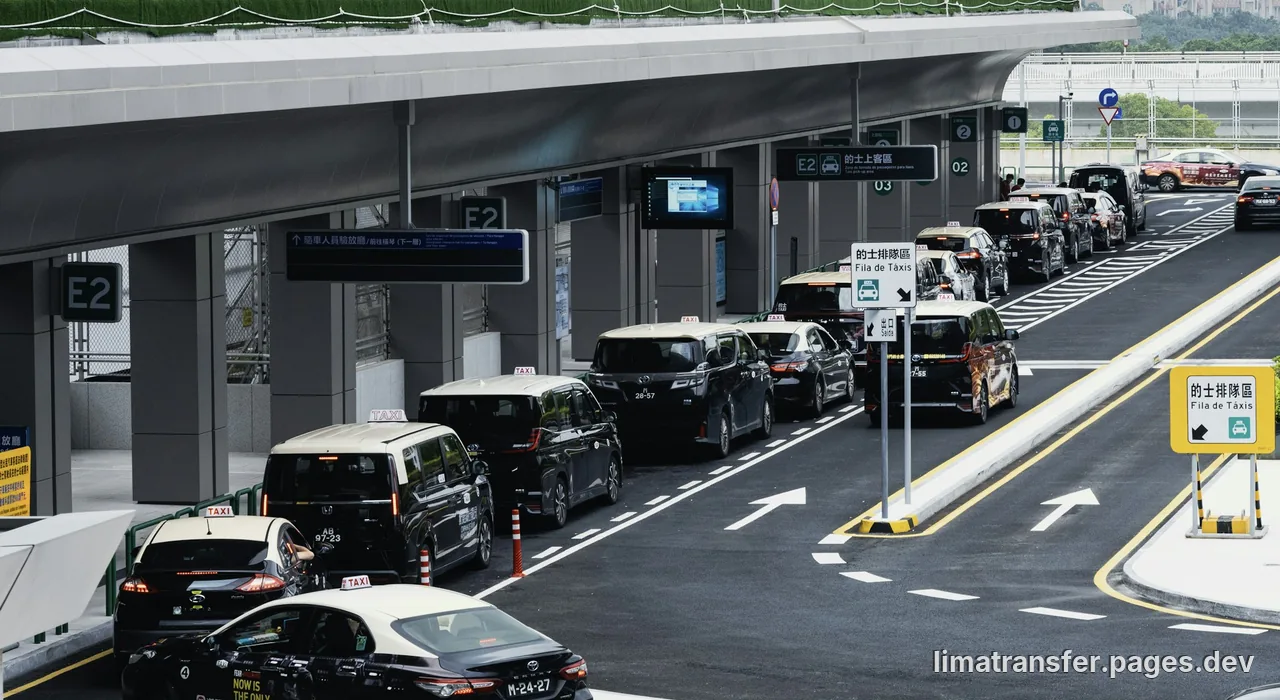
What “Lima airport taxi” actually means in 2026
The phrase “Lima airport taxi” covers four distinct service categories with different price points, vehicle classes, and reliability profiles. Understanding the difference is the single most useful preparation a first-time visitor can do.
Official airport taxi counter taxis. Licensed operators staffing a counter inside the arrivals hall. Fixed-price quotes in soles or dollars, dispatched after you pay. Sedan-class vehicles, professional drivers, printed receipt with plate number. Prices run $18–$45 USD depending on destination.
Pre-booked private transfers. Sedans, SUVs, or minivans booked 24–72 hours before flight through a local operator’s website or WhatsApp. Fixed price, flight tracking, named driver waiting in the arrivals hall with a placard. $18–$80 USD across vehicle tiers and destinations.
Uber and Cabify rideshare. Verified drivers booked through the apps from the official rideshare zone outside the terminal. Dynamic pricing with surge windows. $10–$28 USD across daytime trips, $25–$40 USD during overnight surge.
Unlicensed “taxis.” Unmarked sedans staged in or near the arrivals corridor whose drivers solicit travelers on foot. Not a legitimate service category. They overcharge by 2–3× legitimate rates, sometimes worse, and have a documented history of route detours and theft. Always avoid.
Detailed price comparison by destination
The single highest-value table for travelers planning a transfer:
| Destination | Pre-booked sedan | Counter taxi | Uber/Cabify | Shared shuttle |
|---|
| Miraflores | $22–32 | $28–45 | $15–28 | $10–15 |
| San Isidro | $22–30 | $28–42 | $15–25 | $10–15 |
| Barranco | $25–32 | $32–48 | $18–30 | $12–16 |
| Centro Histórico | $18–25 | $22–35 | $12–22 | $8–12 |
| Callao cruise port | $15–22 | $20–32 | $10–18 | $8–14 |
All prices in USD for daytime travel. Late-night surcharges of $3–$5 USD apply at some operators between 11 PM and 5 AM. Surge pricing on Uber and Cabify can push fares 30–60% higher between 11 PM and 4 AM.
Why the price spread is so wide
The same trip can cost $15 USD or $45 USD depending on operator. The spread reflects three real variables.
Inventory and dispatch overhead. Pre-booked transfers carry a marketing and dispatch cost that the operator bakes into the rate. Rideshare apps have minimal dispatch overhead because drivers self-serve through the app. Counter taxis sit in the middle — a regulated rate that includes the counter clerk’s wages.
Surge pricing dynamics. Uber and Cabify are the only category that surges. Counter taxis and pre-booked transfers hold their rates regardless of demand or time of day. The spread between Uber’s lowest off-peak fare and its highest surge fare is wider than the spread between any two non-rideshare options.
Service standard. Pre-booked transfers include flight tracking, meet-and-greet, and 24-hour dispatch backup. Counter taxis include none of these but offer the fixed-price certainty. Uber and Cabify include the app’s standard features but no meet-and-greet. The price differences reflect what is included.
How to avoid overcharging
Lima’s overcharging risk concentrates in three scenarios:
Accepting rides from drivers who approach you in the terminal. This is the highest-leverage rule. Pre-booked drivers wait with name placards; counter taxis are dispatched after payment at the counter; rideshare drivers are matched through the app. Drivers soliciting passengers on foot are not part of any legitimate service. The overcharge risk on these informal arrangements is 2–3× legitimate rates at minimum, sometimes worse.
Negotiating with curb-side drivers after midnight. The reduced overnight ambient activity sometimes pushes travelers toward the closest available driver at the curb. Counter taxis on their reduced overnight schedule may not be available; the temptation is to grab a curb-side car. Resist. Use rideshare from the official pickup zone or pre-book before arrival. The marginal cost of pre-booking ($5–$10 USD versus rideshare) is worth the certainty.
Accepting flat-rate quotes that “include extra services.” Some unlicensed drivers offer a flat rate that includes a “free city tour” or “free hotel introduction.” These are unworkable in practice and serve as cover for an inflated trip price. Decline. Use the legitimate operator categories.
When the counter taxi is the right choice
The official airport taxi counter is the cleanest fallback when you arrive without a booking and want fixed pricing. The counter premium over Uber ($5–$15 USD) buys three things: no surge risk, guaranteed sedan-class vehicle, and a clerk who confirms the route before dispatch.
Three scenarios where the counter is the right choice:
Arrived without a pre-booking and traveling alone or in a pair with light luggage. The counter handles this cleanly. Walk in, quote your destination, pay, wait 5–10 minutes at the curb for the dispatched driver. Total friction is low.
Overnight arrival when the counter is still open. Between roughly 5 AM and 2 AM the counter runs full service. During overnight surge windows on Uber and Cabify, the counter rate may actually undercut surged rideshare. Worth checking both before deciding.
Travelers uncomfortable with rideshare apps in foreign cities. The counter requires no app, no foreign-currency card setup, no waiting in the pedestrian-bridge staging area. For travelers who prefer human dispatch over app-mediated booking, the counter is the right tool.
When pre-booking saves money over the counter
Pre-booked private transfers consistently run $5–$15 USD below counter taxi rates for equivalent vehicle class. The price advantage compounds with the operational advantage — pre-booked drivers wait inside the terminal, the counter taxi protocol requires you to walk to the counter, pay, then wait at the curb. For travelers landing on long-haul flights from Europe or North America, the meet-and-greet is meaningful comfort.
For repeat travelers and business teams, settling on one local operator like limatransfer.com saves measurable money over a year of trips while improving dispatch reliability. The Lima airport taxi booking experience optimizes around this — operators that handle corporate accounts run smoother on individual trips too.
Closing notes
Lima airport taxi pricing in 2026 is straightforward once you understand the four service categories. Pre-booked transfers and the official counter handle the certainty-first profile; rideshare handles the cost-first daytime profile; shared shuttles and the Airport Express Bus cover budget travelers. Unlicensed taxis are not a service category — they are a scam category. The destination pages on this guide cover the per-route pricing details; the compare page walks the head-to-head economics across the three main legitimate options.